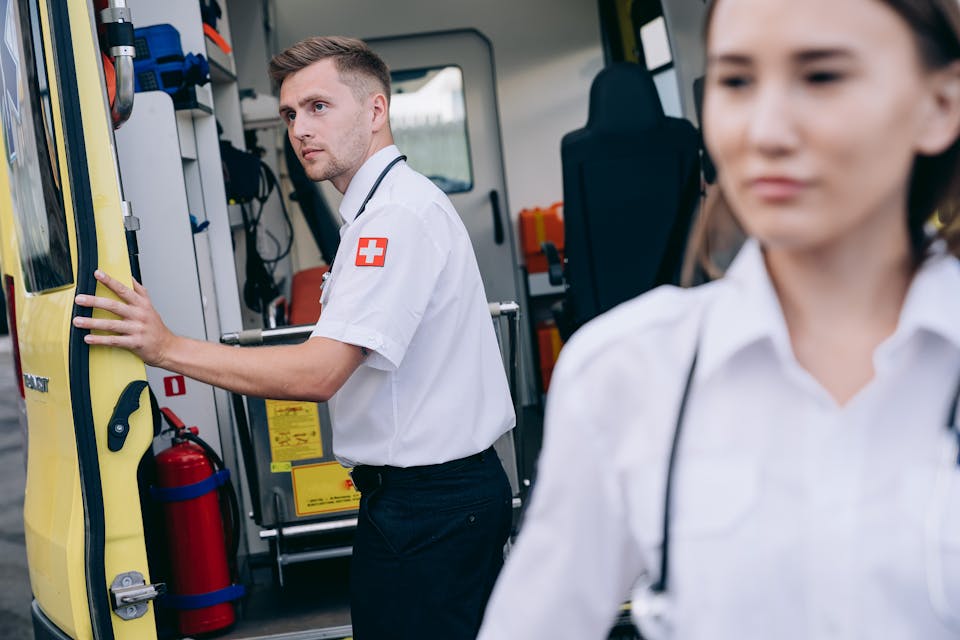
Emergency response services provide life-saving intervention within 72 hours of a dangerous event. These services can include search-and-rescue, specialized triage, shelter, and supplies. Emergency services maintain constant readiness for a range of threats, including medical emergencies, natural disasters, and hazardous materials spills. These ten facts underscore the critical and incredible work of emergency service workers and volunteers.
10 Emergency Response Facts
1. The “golden hours” refer to the first 72 hours after a major disaster. (Source)
This time frame is critical for search-and-rescue operations, triage, and establishing supply lines. Studies show that the first 72 hours are the most critical for saving the most lives in an emergency or missing-person case.
2. Different natural disasters require unique services. (Source)
Earthquakes usually need medical intervention to treat crush syndrome and blunt trauma. Floods require resources to prevent the spread of waterborne diseases and to conduct search-and-rescue operations for people swept away.
3. FEMA has over 4,000 reserves on hand along with Red Cross volunteers. (Source)
These volunteers can be deployed to emergencies across the U.S., supporting FEMA’s response to all domestic disasters and emergencies, both natural and man-made.
4. Senior citizens can use devices to contact emergency services directly and instantly. (Source)
Fall detection devices are invaluable. They can detect when a senior falls and automatically contact emergency services, providing the senior’s exact location.
5. The National Response Framework provides a structure that guides services in responding to all manner of emergencies. (Source)
The organization focuses on five areas: prevention, protection, mitigation, response, and recovery. This framework details how the United States will respond to and prevent loss of life and property in emergencies.
6. Emergency responders follow the “3 Cs” and the “3 Ps.” (Source)
The Cs stand for “check, call, and care,” and the Ps stand for “preserve life, prevent deterioration, and promote recovery.”
7. The Environmental Protection Agency responds to oil spills, chemical spills, and biological and radiological incidents. (Source)
Environmental experts at the EPA understand the science behind cleaning up hazardous releases of contaminants such as petrol, disease, and radiation. This challenging work requires experts to make sure the situation is safe and contained.
8. Everyone can help prepare for an emergency by building a disaster supply kit. (Source)
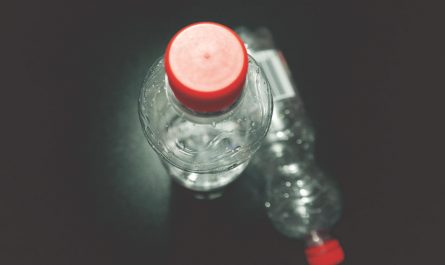
Ready.gov recommends that these kits include items like a flashlight, water, non-perishable food, a first-aid kit, batteries, a dust mask, plastic sheeting, moist towelettes, and a cellphone battery backup or charger.
9. There were $23 billion in weather disasters in 2025. (Source)
These weather events included wildfire, hail, drought, severe thunderstorms, and tornadoes.
10. All of us can benefit from knowing CPR and how to use an AED. (Source)
In some medical emergencies, seconds matter. After contacting emergency services via 911, applying CPR or using a defibrillator can save a life. EMS response time is impressive, but when seconds can mean the difference between life and death, bystanders may need to be the ones to save a life.
Featured image photo credit: Mikhail Nilov